How to Prepare Your Site for a Lowbed Delivery
A lowbed delivery that goes smoothly looks simple from the outside: the trailer arrives, the machine rolls off, everyone gets back to work. In practice, that simplicity is the result of preparation done well before the truck leaves the yard. Most delays and near-misses on delivery day trace back to the same handful of oversights: an access route that was never checked, ground that couldn't take the load, or nobody on site who knew the plan. This guide sets out what a site manager needs to confirm before booking a lowbed and on the day itself.
Checking Access Roads and Gates Before You Book
Before you confirm a delivery slot, walk or drive the actual route the trailer will take from the public road to the unloading point. A loaded lowbed carrying an excavator or wheel loader is long, low, and not built for tight manoeuvring, so problems that a car or even a flatbed truck would shrug off can stop a low-loader completely.
Confirm the following before the truck is mobilised:
- Gate and entrance width: most low-loader combinations need a minimum of 4.5 metres of clear width, more on a curved or angled approach.
- Overhead clearance: check power lines, site signage, gantries, and tree canopies along the full route, not just at the gate.
- Turning radius: a lowbed and prime mover combination can need 15-20 metres of swing room at junctions and site corners. If the route has a tight 90-degree turn, ask your transport provider whether the trailer class can make it or whether an alternative entrance is needed.
- Road surface and gradient: soft verges, steep ramps into basements, or recently laid asphalt that hasn't cured can all cause problems for a fully loaded trailer.
- Weight restrictions on approach roads: some estate roads and bridges carry posted limits that a loaded lowbed will exceed.
If any of these raise doubts, say so when you request the heavy transport service rather than on the day the truck is already en route. A short call beforehand to walk through the site layout saves a wasted mobilisation.
Ground Conditions at the Unloading Point
Access is only half the picture: the ground where the machine will actually come off the trailer has to bear the combined weight of the trailer, the ramps, and the equipment as it transitions from trailer bed to ground. This is where deliveries most often go wrong, because a route can look perfectly fine right up to the last ten metres.
What to check at the unloading area
- The surface is compacted and free of standing water, especially after rain, which is a real factor during the UAE's cooler, wetter months.
- There's no recent backfill or trench work nearby that hasn't fully settled.
- The area is level enough for ramps to sit flat, without the trailer needing to park on a cross-slope.
- Load spread: for softer ground, steel plates or timber matting should be laid out and ready before the trailer arrives, not fetched once it's already parked.
If the unloading point sits on made ground, a recently reclaimed plot, or soft sabkha-type soil common in parts of Abu Dhabi and the wider Emirates, flag this to your transport coordinator in advance. Trailers can be fitted with wider ramps or the offloading point can be relocated to firmer ground nearby, but only if this is known ahead of time.
Preparing the Ramp and Offloading Area
Once the ground itself is confirmed suitable, the immediate offloading zone needs to be cleared and organised:
- Remove parked vehicles, skips, materials, and loose debris from a radius wide enough for the machine to drive or be winched off under full control.
- Mark out an exclusion zone with barriers or cones so other site traffic and personnel stay clear during offloading.
- Confirm there's a safe, flat run-off path for the equipment once it's on the ground: it shouldn't have to immediately negotiate a kerb, trench, or slope.
- If the machine will be driven off under its own power, make sure fuel and battery isolators are ready to be checked by the operator before it moves.
Coordinating Your Site Contact and Banksman
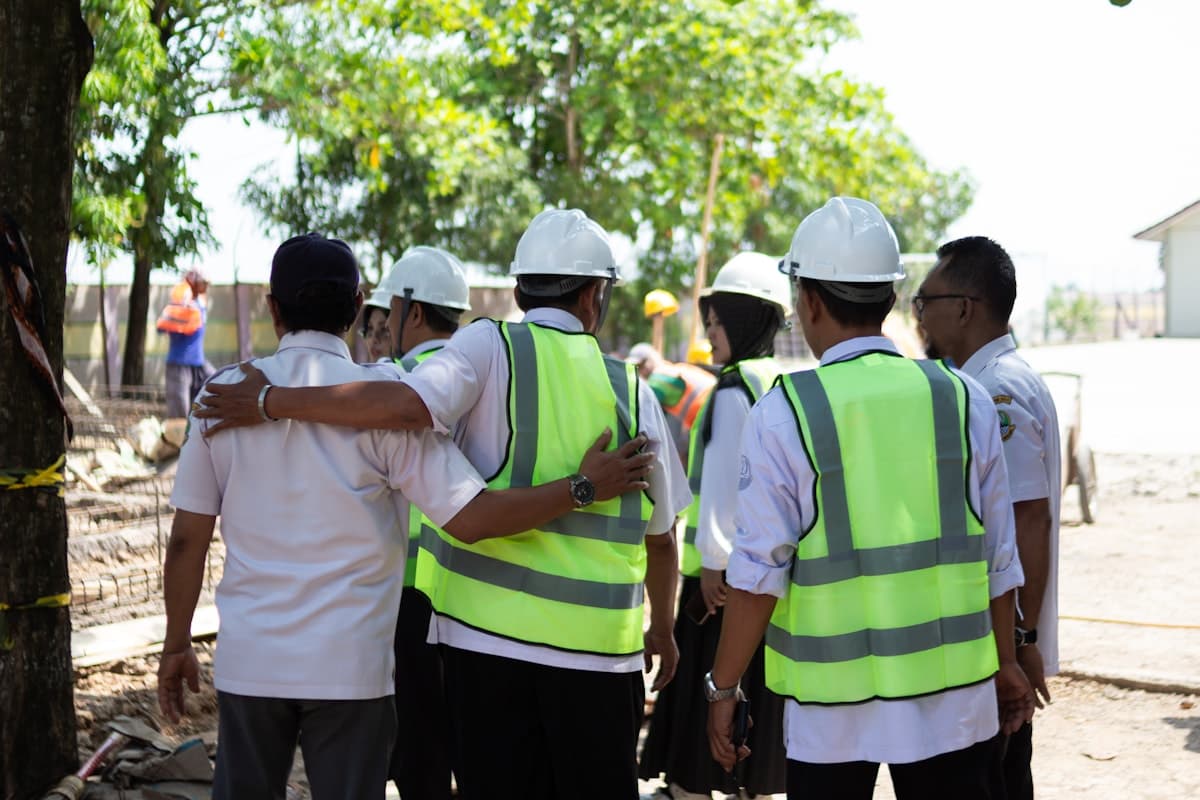
Every lowbed delivery needs one named person on site who is expecting the truck and empowered to make decisions on arrival, not a general site number that rings through to whoever picks up. This contact should be briefed on the offloading plan, the exclusion zone, and any last-minute site changes.
A trained banksman should be present to guide the trailer into position and direct the machine off the ramps. Their job includes:
- Directing the reversing or positioning manoeuvre using clear, agreed hand signals or radio.
- Confirming the exclusion zone is holding before offloading begins.
- Checking ramp angles and trailer stability before the machine moves.
- Signing off the delivery note once the equipment is safely on the ground.
Where the receiving site doesn't have a trained banksman available, ask whether certified operators can be arranged as part of the delivery, many transport providers can supply this alongside the trailer itself.
Timing Deliveries Around Other Site Traffic
Lowbed deliveries move slowly and need space, which makes them a poor fit for peak site traffic hours. Programme deliveries for quieter windows: early morning before concrete pours ramp up, or after the bulk of daily material deliveries have cleared the gate. On active sites in industrial zones, this also avoids conflict with other trucks queuing for the same access point.
If your project is based in a high-density industrial area, this matters even more. Sites running equipment rental in Mussafah or equipment rental in ICAD often share access roads with dozens of other operators, so a delivery slot agreed with your transport provider in advance (rather than a rough "sometime tomorrow" window) avoids gate congestion and wasted standing time for the trailer.
Documentation to Have Ready
Have the paperwork organised before the truck arrives, not while it's idling at the gate:
- Delivery note or job reference number, matched to the transport company's booking.
- Site access permit or security clearance, if the project requires pre-registered vehicles.
- Offloading plan, showing the agreed unloading point, exclusion zone, and route from the gate.
- Contact details for the receiving banksman and site manager, shared with the transport coordinator in advance.
- Any load-specific permits, for oversized or overweight cargo requiring police escort or route approval.
What Commonly Causes Delivery Delays
The same issues account for most avoidable delays:
- Gate or route access that wasn't verified against actual trailer dimensions.
- Ground conditions discovered to be unsuitable only once the trailer is on site.
- No named contact available when the truck arrives, or conflicting instructions from different people.
- Missing or incomplete paperwork at security checkpoints.
- Other vehicles or equipment blocking the offloading area.
- Permits for oversized loads not finalised before the delivery date.
Nearly all of these can be eliminated with a short pre-delivery walk-through and a confirmed point of contact: the preparation costs far less than a stalled trailer and a delayed programme.
Getting this right starts with a conversation before the trailer ever leaves the yard. Share your site layout, access constraints, and ground conditions when you get a quote, and Maxtgc's transport team will confirm the right trailer class, plan the route, and handle any permits an oversized load requires. To coordinate a delivery window or talk through site access, call or WhatsApp +971 56 901 0656, or contact us directly.
Get a Free Quote
Your details open in WhatsApp, ready to send.