Boom Lift vs Scissor Lift: Which Access Platform Do You Need?
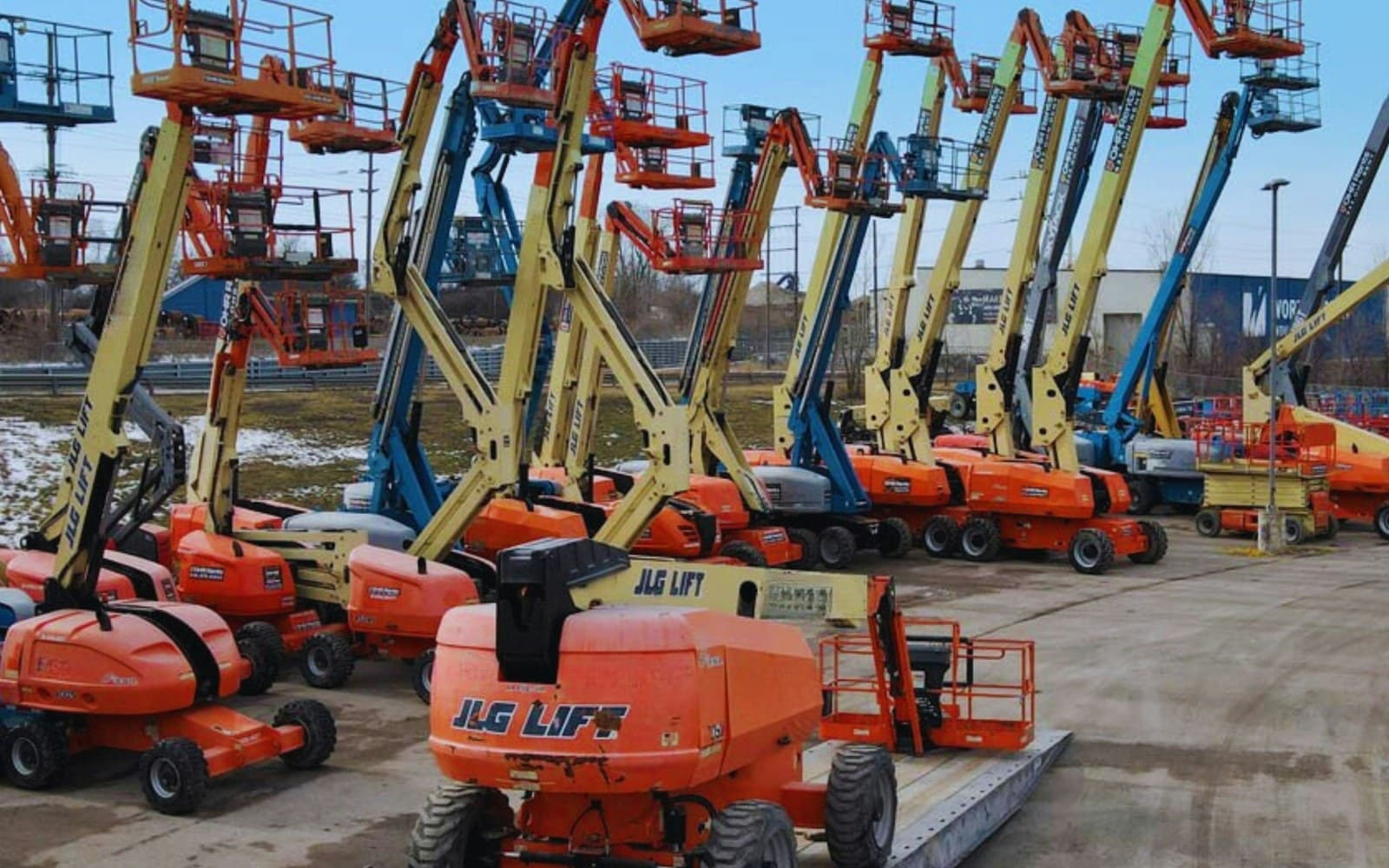
Boom lifts and scissor lifts both put people and tools at height, and both get called "man lifts" on UAE sites. They are built for different jobs. A scissor lift goes straight up and gives you a large, stable platform. A boom lift goes up and out, and gets you to places a scissor lift cannot reach. Hire the wrong one and you either lose time repositioning a boom for overhead work, or you have a crew stretching over a guardrail to reach something the scissor lift cannot get under.
This guide sets out how each machine works, where each one wins, and what to check before booking either on an Abu Dhabi or Dubai site.
The Short Answer
- Work directly above where the machine can stand (ceilings, MEP, racking, lighting): scissor lift.
- Work you need to reach out to, over or around something (façades, canopies, signage, pipe racks): boom lift.
- Work in a courtyard, atrium or behind a narrow door at height: spider lift.
The rest of this article is about the cases that are not that clear.
How Each Machine Works
Scissor Lifts
A scissor lift raises its platform on a folding, criss-cross mechanism. The platform stays directly over the chassis the whole way up, which keeps it stable and lets it be large: room for two or more people, their tools and a load of materials. Many have a deck extension that slides out a metre or so at one end.
Electric scissor lifts run on batteries and are the standard machine indoors: quiet, no exhaust, non-marking tyres. Rough-terrain scissor lifts have four-wheel drive, more ground clearance and a wider base for outdoor sites and unfinished ground.
Boom Lifts
A boom lift carries a smaller platform, often called a basket or cage, on the end of a hydraulic arm mounted on a rotating turntable. That arm can reach up and out from the base, and the turntable lets it swing round without moving the machine.
Articulating booms have one or more knuckles, so they can go up, over an obstacle and then down or in. Telescopic booms extend in a straight line and give more height and outreach for the size of the machine.
Side-by-Side Comparison
| Scissor lift | Boom lift | |
|---|---|---|
| Movement | Straight up | Up, out and around |
| Platform size | Large, room for materials | Small, people and hand tools |
| Typical platform capacity | About 230 to 450 kg electric, more on rough-terrain | About 230 to 300 kg |
| Outreach | Deck extension only | Several metres, varies by model |
| Best for | Overhead work above the machine | Façades, over obstacles, at a distance |
| Repositioning | Quick for repeated overhead work | Slower, but reaches more from one spot |
| Footprint | Compact, narrow models fit through doors | Larger base and tail swing |
Figures are typical for each class, not a specific machine. Always check the specification of the unit you are hiring.
When to Choose a Scissor Lift
A scissor lift is the better machine when the work is spread across a ceiling or along a wall directly above where the lift can drive. Ductwork, sprinkler pipes, cable trays, ceiling grids and lighting are all scissor lift jobs. The large platform holds lengths of duct or pipe and a crew to install them, and moving to the next section is a short drive.
It is also the usual choice in warehouses, both for installing racking and for maintenance afterwards. Electric units are quiet and clean enough to work while a building is occupied, and the narrowest models, around 0.8 metres wide, pass through a standard doorway.
Outdoors, a rough-terrain scissor lift does the same job on unpaved ground: steel at low level, signage on a single-storey building, work on a canopy from below.
When to Choose a Boom Lift
Choose a boom lift when something stands between where the machine can go and where the work is. That might be a landscaped strip along a façade, a canopy over an entrance, a pipe rack in a plant, or a ground floor you cannot drive onto. An articulating boom can reach over the obstacle and drop down to the work face.
Boom lifts also suit work spread over a large vertical area. On a façade, a telescopic boom can reach several floors from one position, where a scissor lift would only reach the bottom of the elevation. For glazing, cladding inspection and signage on mid-rise buildings in Abu Dhabi and Dubai, a boom lift is usually the starting point.
The trade-off is platform space. A boom basket takes two people and hand tools. Heavy panels or long materials need a crane or a separate lifting method.
Where Spider Lifts Fit In
A spider lift is a compact boom on tracks with outriggers. It folds small enough to go through a standard door, travels across finished floors without marking them, and once its outriggers are set it reaches heights comparable to a much larger wheeled boom. Atriums, hotel lobbies, courtyards and interiors with no vehicle access are where spider lifts earn their place. They take longer to set up than a wheeled machine, so they are a planned booking rather than a same-day one.
Working Height vs Platform Height
Specification sheets quote either platform height (the floor of the platform) or working height (roughly 2 metres more, the reach of a person standing on it). Mixing them up is the most common reason a lift arrives on site a couple of metres short.
To size a machine, take the height of the highest point you need to work at and subtract 2 metres for the platform height. For a boom lift, also measure the horizontal distance from where the machine can stand to the work, and check the machine's range chart, which shows how high it can reach at each outreach.
Ground, Floors and Wind
Ground. Both machines put their weight onto small contact areas, and a boom lift with its arm extended concentrates more of it on one side. Soft sand, recently backfilled trenches and covered drains or voids are the main hazards on UAE sites. Indoors, check that suspended slabs, mezzanines and podium decks are rated for the machine's weight.
Wind. Every platform has a maximum wind speed set by the manufacturer, and some electric scissor lifts are rated for indoor use only. Wind can pick up during the day, so check the forecast and the manufacturer's limit before planning outdoor work at height. The midday work break from mid-June to mid-September also applies to outdoor platform work in direct sun.
Operators and Training
Whoever operates the lift needs training for that category of machine. IPAF certification is the widely used qualification for both scissor lifts and boom lifts; check what your site requires. In a boom lift, everyone on the platform should wear a full-body harness with a short lanyard clipped to the designated anchor point. In a scissor lift, the guardrails are the main protection, but some sites require harnesses on every platform, so check the site rules before work starts.
If your crew is not certified, hiring the lift with an operator is usually simpler than arranging training for a short job. Our guide to equipment rental with operator vs self-drive covers the trade-off.
What to Tell Your Supplier
To get the right machine first time, send:
- The height of the highest point you need to work at
- Any outreach needed, and what is in the way
- Indoor or outdoor, and the floor or ground type
- The narrowest door or opening on the way in, and any floor loading limits
- Dates, hours and whether you need an operator
Maxtgc rents electric and rough-terrain scissor lifts, articulating and telescopic boom lifts and spider lifts across Abu Dhabi and Dubai, with IPAF-trained operators available. See our boom lift rental and scissor lift rental pages, the full access equipment range, or request a quote with your work height and site details.
Get a Free Quote
Your details open in WhatsApp, ready to send.